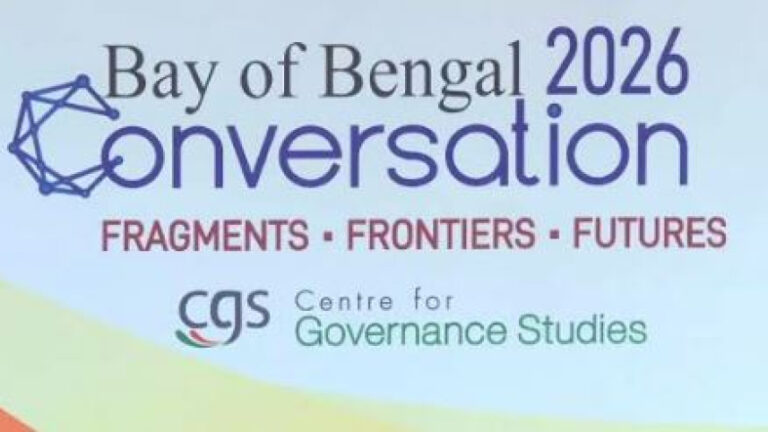
The Centre for Governance Studies (CGS) has issued a public statement on the non-participation of transgender rights activist Hochemin Islam in the Bay of Bengal Conversation 2026. The organisers say they advised her not to attend because of serious security concerns that followed an online campaign against her. The statement was released on Friday, 9 October 2026, and reported by UNB and New Age on 10 October. It came after Hochemin’s own account of her exclusion had been published by Rokeya Collective on 5 October and by Ajker Patrika on 9 October. In those reports she alleged that her confirmed invitation had been withdrawn by telephone on the evening of 2 October.
In its statement, CGS said it had “taken note of the concerns” raised by Hochemin and her organisation. It noted that she had taken part in several CGS initiatives, including previous editions of the Bay of Bengal Conversation, and said her invitation to the 2026 conference reflected that “longstanding commitment.” According to CGS, “an organized campaign of hostility, intimidation and threats” emerged on social media shortly before the event, targeting Hochemin, her community and the organisation. CGS said that, against the backdrop of “growing mob intimidation in Bangladesh,” this raised serious concerns for the safety of those involved and for the peaceful conduct of the international gathering.
CGS confirmed that its President, Zillur Rahman, personally contacted Hochemin and advised her against attending. It described this as “a difficult decision made in response to serious security concerns, not because of her identity, views or advocacy.” The organisation also stated: “There was no instruction, request or pressure from the government or any government authority to exclude her.” On the removal of her name and photograph from conference materials, CGS said that updating programme and publicity materials after a change in speaker participation is “a routine administrative practice” also applied to other speakers, and that it was “neither personal nor discriminatory.”
The statement acknowledged that the outcome “was disappointing and may have caused understandable hurt,” and said CGS respects Hochemin’s right to raise questions and express her concerns. CGS said it “firmly rejects the idea that intimidation or mob pressure should determine who can participate in public discourse.” At the same time, it said it “cannot disregard genuine threats to the safety of those we invite.” The organisation reaffirmed its commitment to the rights and inclusion of transgender people and said it remains open to constructive dialogue with Hochemin, her community and other stakeholders. It closed with the words: “No one should be excluded because of who they are. No one should be endangered simply to demonstrate a principle.”
The statement confirms several central elements of Hochemin’s account:
- She had been invited.
- The CGS President personally told her not to attend shortly before the event.
- Her name and photograph were removed from conference materials afterwards.
It also confirms that the decision followed a hostile online campaign directed at her. CGS frames the decision as a protective measure taken in response to that campaign.
The statement does not address several issues Hochemin raised earlier:
- Her allegation that she was asked not to disclose the telephone conversation, including to her own community.
- The absence of any formal written explanation.
- The lack of follow-up communication about her safety after the call.
- Why the security risks were not assessed before she was invited.
- Why measures to secure her participation were not considered, given the security arrangements in place for senior political figures attending the conference.
The CGS statement is the organisers’ account of their reasoning. It has not been independently verified, and the internal decision-making process remains unclear. The incident nonetheless documents that a hostile online campaign against a transgender rights activist resulted in her being withdrawn from an international public dialogue. Faced with that campaign, the organisers chose to remove her from the platform rather than to secure her participation. This raises continuing questions about who bears the cost when institutions respond to intimidation, and about how public forums in Bangladesh can protect the participation of people targeted because of their gender identity.
References
- UNB — “CGS explains why trans activist Ho Chi Minh Islam didn’t appear in BoBC 2026,” 10 October 2026. Read the UNB report
- New Age — “Safety threats forced decision on Ho Chi Minh Islam’s BoBC participation: CGS.” Read the New Age report