Hochemin Islam Barred from Bay of Bengal Conversation 2026
9 October 2026
Transgender rights activist and transfeminist Hochemin Islam was prevented from attending the Bay of Bengal Conversation 2026 in Dhaka despite having received confirmation of her participation from the organisers, according to her account reported by multiple news outlets. The international conference, organised by the Centre for Governance Studies (CGS), took place from 3 to 5 October 2026 at the Pan Pacific Sonargaon Hotel in Dhaka. It brought together political leaders, diplomats, policymakers, academics, journalists, business representatives and civil society actors to discuss regional and international issues, including geopolitics, governance, technology, democracy and human security. Hochemin had been invited to participate in the conference, but shortly before the event, opposition to her participation emerged on social media. She subsequently alleged that CGS President Zillur Rahman instructed her not to attend, citing concerns about her personal safety and security.
According to Hochemin, she initially registered for the conference and received confirmation from CGS. The organisers later contacted her by email regarding participation in a studio discussion with a representative from Thailand. The conference programme also included a session titled "Governing Diverse Societies", in which she had been expected to participate. Following these arrangements, Hochemin returned to Dhaka from Hyderabad, India, on 1 October 2026. Her travel expenses were being covered by a German organisation. However, on the evening of 2 October, she received a telephone call from Zillur Rahman informing her that she should not attend the conference because of security concerns. Hochemin stated that she was told her safety was the highest priority and that avoiding the event would be preferable. She further alleged that she was asked not to disclose the conversation to anyone, including members of her own community. She requested that the organisers inform the German organisation supporting her travel about the cancellation, but said that no further communication or formal written explanation was provided.
The withdrawal of Hochemin's participation followed growing hostility on social media. On 2 October, reports emerged concerning objections to her inclusion in the conference programme. Daily Inqilab reported that National Citizen Party leader Sarjis Alam and former BRAC University teacher Asif Mahtab Uts had criticised her participation. The controversy was also linked to social media claims that Hochemin and Dr Zubaida Rahman, wife of Prime Minister Tarique Rahman, would appear together at the international conference. Some of the reactions questioned the presence of a transgender rights activist at an event attended by prominent political figures. According to Hochemin, the online campaign targeted her identity and participation, creating concerns about her personal safety. She said she had informed a CGS representative about the situation before receiving the telephone call from Zillur Rahman.
On 2 October, the Prime Minister's Deputy Press Secretary Shahadat Hossain Shadhin publicly rejected claims that Dr Zubaida Rahman and Hochemin Islam would share the same stage at the conference. According to reports published by Jamuna Television and Channel 24, the Deputy Press Secretary stated that the organisers had also confirmed that the two individuals were not scheduled to appear together. He urged social media users not to circulate unverified information. The distinction was significant because the circulation of their names in connection with the same international conference did not establish that they were scheduled to participate in the same session. Hochemin's invitation concerned a separate discussion, and the published programme placed the two participants in different sessions. Therefore, the official denial concerning a shared stage did not contradict Hochemin's account that she had originally been invited to participate in the conference.
On 5 October, Rokeya Collective published a report documenting Hochemin's exclusion from the conference and questioning the organisers' handling of the situation. The report stated that her invitation had been withdrawn on 2 October, three days before the scheduled session. Rokeya Collective also reported that it had attempted to contact both Hochemin and CGS to obtain their accounts of the incident. While Hochemin provided her account, CGS had not responded to the publication's email by the time the report was published. Hochemin questioned why the organisers had not assessed possible security risks before inviting her. She also asked whether excluding her at the last moment was the only available response if the security situation had changed after the invitation. Referring to the security arrangements available for senior political figures attending the conference, she questioned why similar efforts could not be made to ensure that an ordinary citizen could participate safely in an international dialogue.
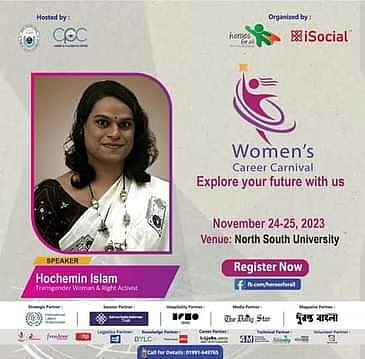
Hochemin also connected the incident to an earlier experience at North South University in November 2023, when her scheduled participation in a university event was cancelled shortly before the programme following opposition to her presence. Speaking to Rokeya Collective, she described the Bay of Bengal Conversation incident as another example of being excluded from a public platform after initially receiving an invitation. She emphasised that her principal means of participation in public life was her ability to speak about rights and represent the concerns of marginalised communities. Her comments raised questions about the extent to which institutions organising public discussions are prepared to protect the participation of individuals facing hostility because of their gender identity.
In a further account published by Ajker Patrika on 9 October, Hochemin alleged that CGS had removed her photograph and promotional materials from its social media platforms following the telephone conversation with Zillur Rahman. She said that she had sent screenshots of hostile online posts to him through WhatsApp but had received no response. According to her account, the organisers did not subsequently contact her to check whether she was safe or facing additional threats. She also stated that she initially remained silent about the cancellation because she had been asked not to disclose the conversation, while individuals opposing her participation continued discussing the matter publicly. Hochemin described the experience as humiliating and connected it to her academic research on the experiences of marginalisation and humiliation faced by disadvantaged communities. She said that although she was studying such experiences as part of her doctoral research abroad, she had now personally encountered a similar situation.
Hochemin further expressed concern about the broader safety and freedom of expression of transgender people in Bangladesh. In her interview with Ajker Patrika, she argued that transgender communities had historically faced discrimination, insecurity and attempts to restrict their voices. She also expressed the view that their situation had become more difficult following the political changes of 2024. These observations were presented as her assessment of the wider environment affecting transgender people rather than as independently established findings of the conference incident. Her account nevertheless placed the cancellation within a broader discussion about whether marginalised individuals can participate in public dialogue without being subjected to hostility or exclusion.
The Bay of Bengal Conversation proceeded from 3 to 5 October without Hochemin's participation. Available reporting establishes that she had been included in the conference arrangements, that opposition to her participation circulated online, and that she was subsequently informed that she should not attend because of security concerns. Hochemin additionally alleged that her promotional materials were removed and that she received neither a formal written explanation nor subsequent communication concerning her safety. The organisers' detailed account of the decision was not available in the reviewed reports, and Rokeya Collective stated that CGS had not responded to its request for comment at the time of publication. Consequently, the precise internal decision-making process and whether considerations beyond the stated security concerns influenced the cancellation could not be independently established. The incident nevertheless documented the exclusion of a transgender rights activist from an international dialogue following public opposition to her participation, raising questions about institutional responsibility, inclusive representation and the protection of marginalised participants in public forums.
References
Reports Hochemin Islam's detailed account of her confirmed participation, invitation to a studio discussion, return to Dhaka, the alleged telephone call from CGS President Zillur Rahman, hostile social media reactions, removal of promotional materials, and the absence of a formal explanation or subsequent communication concerning her safety.
Read the Ajker Patrika reportDocuments the withdrawal of Hochemin Islam's invitation to the Governing Diverse Societies session, her questions concerning the organisers' security assessment, the online controversy preceding the decision, and the publication's unsuccessful attempt to obtain a response from CGS.
Read the Rokeya Collective reportProvides contemporaneous evidence of public and political opposition to Hochemin Islam's expected participation in the conference, including criticism attributed to Sarjis Alam and Asif Mahtab Uts. The report is cited as evidence of the opposition and public controversy, not as an endorsement of its characterisation of Hochemin's identity.
Read the Daily Inqilab reportReports the statement of Deputy Press Secretary Shahadat Hossain Shadhin rejecting social media claims that Dr Zubaida Rahman and Hochemin Islam would share a stage at the Bay of Bengal Conversation. The report distinguishes the disputed shared-stage claim from participation in the wider conference.
Read the Jamuna Television reportProvides additional reporting on the Deputy Press Secretary's clarification concerning the claim that Hochemin Islam and Dr Zubaida Rahman would appear together at the conference, including the organisers' reported confirmation that they were not scheduled to share a stage.
Read the Channel 24 reportThe organising institution's official event listing confirms the conference dates and provides institutional context for the fifth edition of the Bay of Bengal Conversation held in Dhaka.
View the official CGS event listingThe official conference website identifies the Centre for Governance Studies as the organiser and confirms that Bay of Bengal Conversation 2026 was scheduled for 3–5 October at the Pan Pacific Sonargaon Hotel in Dhaka. It also provides information about the conference's objectives, thematic pillars and international participation.
Visit the official conference website