Chhatra Dal and Chhatra Shibir Clash at Dhaka University Amid Controversy Over Same-Sex Allegations
2 August 2026
Activists of Jatiyatabadi Chhatra Dal and Islami Chhatra Shibir clashed at the University of Dhaka’s Dr Muhammad Shahidullah Hall on 2 August 2026 as the hall administration was investigating allegations of same-sex conduct involving two visitors who had stayed in the room of Hall Students’ Union Assistant General Secretary Ibrahim Khalil. The confrontation took place in and around the hall provost’s office, where the investigation committee was conducting its inquiry, and left at least two people injured according to contemporary reporting. The clash came a day after videos involving the two visitors began circulating widely on social media, turning an allegation concerning their private conduct into a broader campus controversy. Both Chhatra Dal and Chhatra Shibir subsequently accused the other of initiating the violence, while rhetoric surrounding the confrontation increasingly framed homosexuality itself as part of the political dispute.
According to witnesses and multiple news reports, the hall administration had summoned Ibrahim Khalil and his roommate in connection with its investigation into the incident. Tensions developed at the provost’s office while the inquiry was underway, as activists from both student organisations gathered around the office. Chhatra Dal leaders alleged that they had gone there to demand accountability over the incident and accused Chhatra Shibir of attempting to protect Khalil. Shahidullah Hall Chhatra Dal convener Mosaddiq Al Haque Shanta alleged that Shibir was trying to shield the Hall Union AGS by “promoting homosexuality” and spreading false information. Chhatra Dal representatives also raised allegations concerning CCTV footage and questioned whether evidence relevant to determining Khalil’s presence at the time of the original incident had been removed. They claimed that Shibir activists attacked Chhatra Dal members during the confrontation and that several of their activists were injured. The use of allegations about “promoting homosexuality” in this dispute was significant because it expanded the controversy beyond questions of individual responsibility or the conduct of an investigation, turning perceived support for or protection of people accused of same-sex conduct into a political accusation against an opposing student organisation.
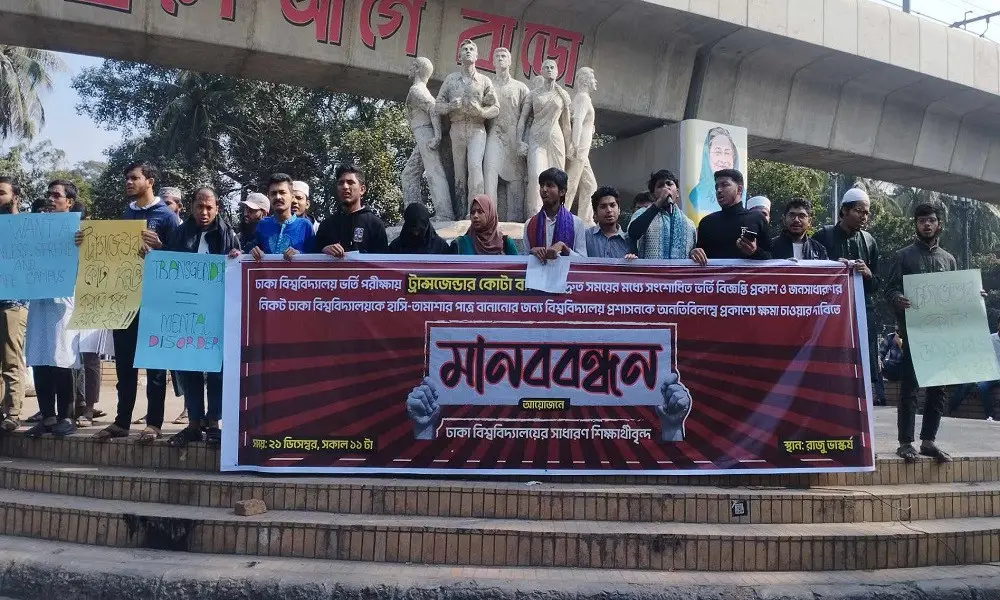
Chhatra Shibir and representatives of the Hall Students’ Union presented a sharply different account. Hall Students’ Union General Secretary Toukir Hasan said Khalil and his roommate had been called before the investigation committee and alleged that Chhatra Dal activists entered the area while the proceedings were underway. According to his account, house tutors asked those present to leave the provost’s office, after which tensions continued outside. Toukir alleged that a Shibir activist was assaulted after being accused of taking photographs and that Shibir members subsequently took shelter inside the provost’s office. He further alleged that another confrontation occurred when someone attempted to record the situation on video. Shibir maintained that Chhatra Dal had initiated the attacks and later brought out a protest procession on campus, marching from Madhur Canteen and holding a rally at the Raju Memorial Sculpture. Contemporary reports therefore presented competing accounts of how the violence began, with neither side accepting responsibility and each accusing the other of disrupting or exploiting the investigation.
The confrontation demonstrated how rapidly the allegations involving the two visitors had moved beyond the individuals directly affected. What began as an allegation concerning two men inside a residential hall room on 27 July had, within days, resulted in recorded statements being circulated online, public scrutiny of their perceived sexual orientation, an administrative investigation and then a physical confrontation between two major student political organisations. During this escalation, homosexuality was not discussed only as the subject of the original allegation; it became part of the language through which political opponents accused one another of wrongdoing. In particular, claims that an opposing group was protecting or “promoting homosexuality” contributed to a wider hostile narrative around the incident, even though the hall administration’s investigation into the underlying allegation had not reached a final conclusion.
Dhaka University Proctor Professor Israfil Ratan described the confrontation as a temporary flare-up between the two groups and said a mobile team of assistant proctors had been sent after the university authorities were informed of the situation. Reports also indicated that teachers intervened as tensions escalated. By the end of the day, however, the original allegation involving the two visitors had become intertwined with competing political narratives, accusations of protecting homosexuality and public demonstrations by student organisations. For LGBTIQ+ rights monitoring, this development is significant because it illustrates how an allegation concerning actual or perceived same-sex conduct can move quickly from the private sphere into institutional and political conflict, while anti-LGBTIQ+ rhetoric can be deployed as a means of discrediting political opponents. The clash also intensified public attention around an incident in which the sexual orientation of the two visitors had not been independently established and in which subsequent accounts would raise serious questions about the circumstances under which their recorded statements had been obtained.
References
Reports on the confrontation at the provost’s office during the investigation and presents allegations made by both Chhatra Dal and Chhatra Shibir.
Provides detailed accounts from both student organisations and reports that at least two people were injured during the confrontation.
Contains detailed competing accounts of the confrontation and reports the Chhatra Dal allegation that Shibir was protecting the AGS by “promoting homosexuality”.
English-language reporting on the investigation, confrontation and rhetoric used by the two organisations.
Reports on the confrontation at the Shahidullah Hall provost’s office and the competing allegations surrounding the incident.
Reports on the investigation meeting, the confrontation between the two student groups and Shibir’s subsequent protest procession.
Additional contemporary Bangla reporting on the clash during the hall administration’s investigation.