
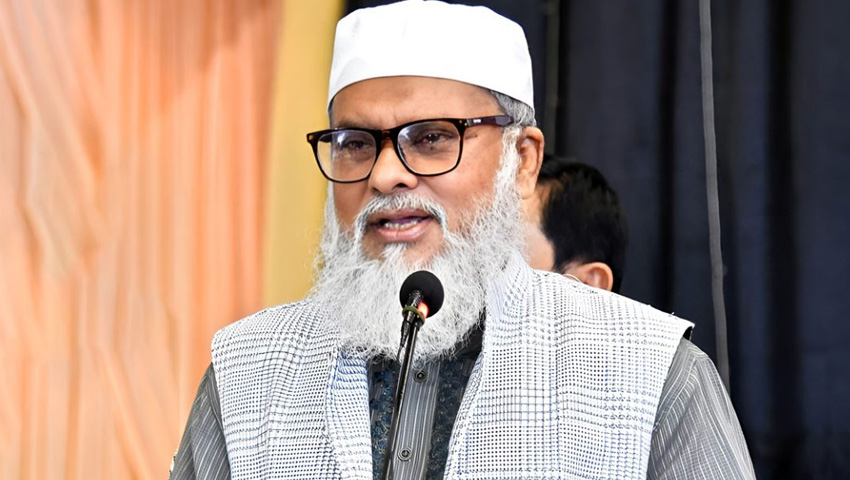
Bangladesh’s interim government’s Religious Affairs Adviser, Dr A F M Khalid Hossain, has sparked controversy after describing transgender identity as a “major fitna of the modern era.” He made the remarks on Thursday, 2 October, during a book-launch ceremony at the Islamic Book Fair held near the eastern gate of Baitul Mukarram National Mosque in Dhaka. The event marked the unveiling of Modern Thoughts and Ideologies, a book written by Professor Dr Ahmad Ali. Speaking as the chief guest, the Religious Affairs Adviser made negative remarks about transgender identity, portraying it as a religious and social problem.
During his speech, Khalid Hossain commented on the identities and physical characteristics of transgender individuals, stating, “A boy has male genitalia and a beard. But he takes injections to change his voice, reduces his beard, and dresses as a woman.” Through these remarks, he described transgender women primarily in terms of their sex assigned at birth and physical characteristics. Rather than recognising transgender identity as an individual’s gender identity, his statement associated it with physical modifications, clothing, and outward appearance. Such a characterisation does not adequately reflect the diversity of gender identities or the lived experiences of transgender people.
At the same event, the Religious Affairs Adviser drew a distinction between Hijra or third-gender people and transgender individuals. According to a news report, he stated, “Third-gender people are our brothers and sisters, just like us. Movements are organised for them, and demands are raised to establish their rights. But transgender people are different—a man thinks he is a woman, or a woman thinks she is a man.” While his statement acknowledged the importance of protecting the rights of Hijra people, it simultaneously questioned the legitimacy of transgender identities. Although Hijra and transgender identities have distinct cultural and social contexts, they are not entirely separate categories. In Bangladesh and across South Asia, many Hijra individuals also identify as transgender.
Transgender and other gender-diverse communities in Bangladesh have long experienced social discrimination, identity-based harassment, and barriers to accessing education, employment, and healthcare. Against this backdrop, describing transgender identity as a “fitna,” a religious term commonly associated with trials, discord, or temptation, carries particular significance when expressed by a senior government official. Presenting the identity of an already marginalised community in negative religious terms may reinforce existing social stigma, misconceptions, and prejudice. Statements that question the legitimacy of transgender identities can also raise concerns about the dignity, equal rights, and safety of transgender individuals. However, the available news reports do not establish whether this particular statement directly resulted in any incidents of violence.
Khalid Hossain’s remarks represent a notable example of how transgender and gender-diverse identities have been publicly discussed by representatives of the Bangladeshi government. His distinction between recognising the rights of Hijra people and portraying transgender identity negatively reflects broader misunderstandings surrounding gender diversity. Statements made by individuals holding public office can influence societal attitudes towards marginalised communities and may affect the broader environment for social acceptance, equal rights, and inclusion.
References
- Daily Inqilab — Report on the Religious Affairs Adviser’s remarks describing transgender ideology as a major fitna of the modern era, 3 October 2025.
Read the Daily Inqilab report - Barta Bazar — Report on the Religious Affairs Adviser’s remarks describing transgenderism as a major fitna of the modern era, 2 October 2025.
Read the Barta Bazar report - 36News — Report on the Religious Affairs Adviser’s remarks describing transgenderism as a major fitna of the present era, 3 October 2025.
Read the 36News report