Islamist Group Demands Abolition of Transgender Employment Quota in Bangladesh
5 September 2025 | Dhaka, Bangladesh
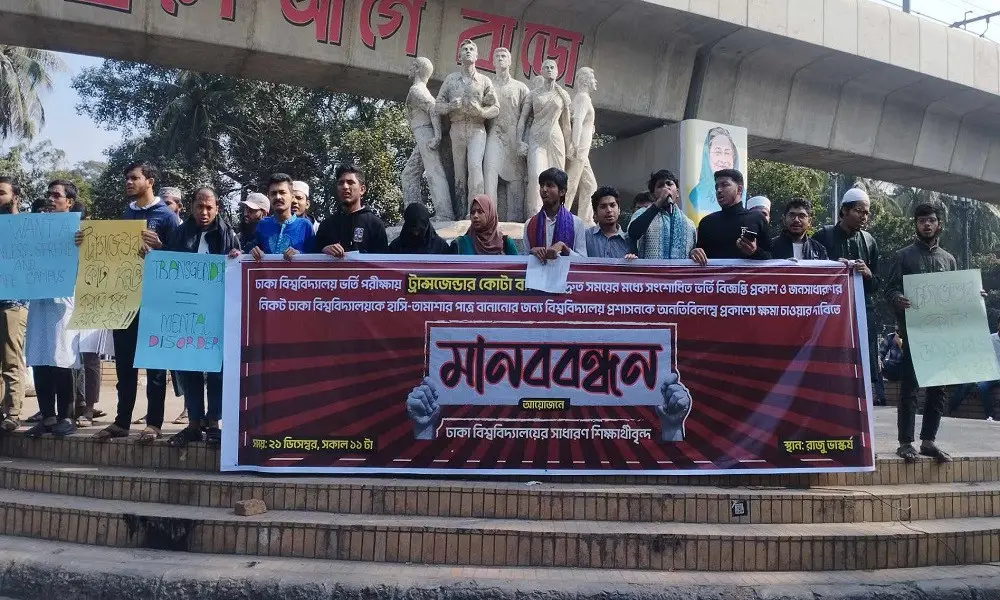
On 3 September 2025, an organisation called Mullobodh Andolon (Values Movement) organised a human chain in front of the National Press Club in Dhaka, demanding changes to recruitment and education policies that included the abolition of the reserved quota for third-gender people in government employment. The programme began at around 11:00 a.m. and brought together religious figures, academics, professionals and supporters of the organisation. The demonstration was organised around several connected demands concerning primary education and government recruitment: the participants opposed the recruitment of music teachers in government primary schools, demanded the appointment of dedicated Islamic religious education teachers, and called for the cancellation of the government employment quota reserved for third-gender people. Former secretary Nurul Alam presided over the programme, while Mullobodh Andolon convener Dr. Mohammad Sarwar Hossain, spokesperson Engineer Muhammad Sadat and other participants addressed the gathering.
During the human chain, Dr. Mohammad Sarwar Hossain argued that although Muslims constitute the overwhelming majority of Bangladesh's population, government primary schools did not have dedicated teachers for Islamic education, while the authorities were moving to recruit music teachers. He connected this criticism with the existence of a quota for third-gender people in government recruitment and alleged that such policies were inconsistent with Bangladesh's social and cultural context. In his speech, he associated the recognition and recruitment of transgender people with homosexuality and claimed that an agenda similar to homosexuality was being introduced into the education system through the quota. He further argued that such measures would create division and conflict within educational institutions. The organisation therefore presented its opposition to the third-gender quota alongside its campaign against music-teacher recruitment and in favour of dedicated Islamic education teachers.
The speakers repeatedly sought to distinguish people they described as "Hijra by birth" from transgender people while arguing against employment protections associated with third-gender identity. Mullobodh Andolon spokesperson Engineer Muhammad Sadat stated that the organisation had no objection to people who were Hijra from birth, but objected to the use of the "third gender" category because, according to him, transgender and homosexual people could obtain opportunities through it. This argument blurred distinct concepts of Hijra identity, transgender identity and sexual orientation while portraying transgender and gay people as groups whose access to reserved government employment should be prevented. Participants consequently called for the quota to be abolished rather than merely clarified or administratively revised. Their demands concerned access to public employment and, in the context of the demonstration, were closely linked to opposition to the possibility of transgender people entering the teaching profession.
This opposition was also expressed through slogans and placards displayed publicly during the human chain. One placard declared, "When the teacher is homosexual, society declines," while another stated, "Being Hijra is heavenly, third gender is satanic." The messages portrayed Hijra identity as acceptable only within a narrowly defined understanding of being born Hijra while presenting third-gender and transgender identities in explicitly derogatory religious terms. Through the speeches, banners and placards, opposition to a government recruitment policy was therefore accompanied by public rhetoric targeting transgender and gay people and questioning their legitimacy as teachers and beneficiaries of employment protections.
At the conclusion of the programme, Mullobodh Andolon presented a set of demands concerning primary education and public employment. The organisation called on the government to prioritise improving Bangla, English and mathematics education at the primary level, appoint dedicated teachers for Islamic religious education, cancel the recruitment of music teachers in government primary schools, and abolish the quota reserved for third-gender people in government employment. The demonstration thus brought together opposition to music education and opposition to transgender inclusion within a broader campaign over the direction of primary education and government recruitment. While speakers stated that they did not oppose people they considered to be Hijra by birth, their demand sought the removal of an existing employment measure covering third-gender people, and the public campaign accompanying that demand included hostile characterisations of transgender and gay people and opposition to their inclusion in the teaching profession.